Agile: Change Is Expected—but It Is Still Managed
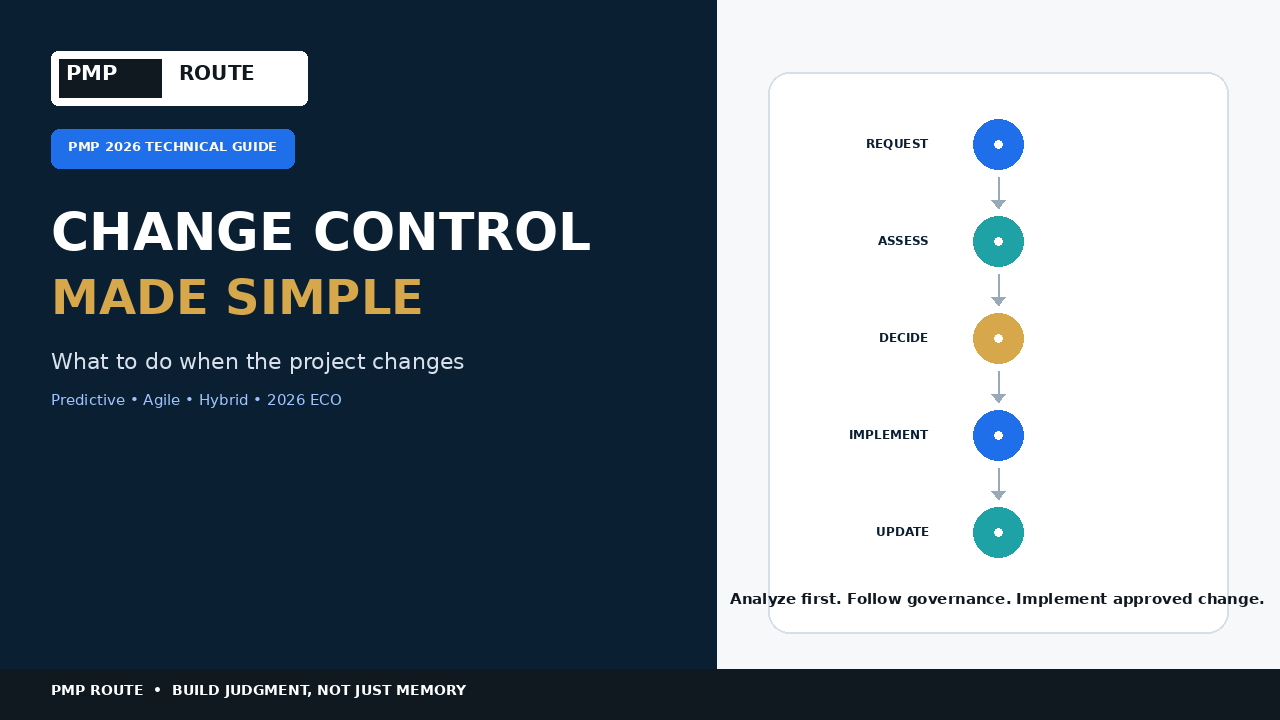
PMP 2026: Change Control Made Simple
What Should You Do When the Project Changes?
A stakeholder asks for a new feature.
The client wants something delivered earlier.
A regulation changes.
The team discovers that the original solution will not work.
These situations appear simple, but change questions are some of the easiest PMP questions to get wrong because candidates often react too quickly.
After working with PMP candidates, I see the same mistake repeatedly:
They jump from “someone requested a change” directly to “let's implement the change.”
For the PMP exam—and for good project management—there is usually something important in between:
Understand → assess → follow governance → decide → implement → update.
The July 2026 PMP Exam Content Outline specifically includes Manage and control changes within the Business Environment domain. PMI expects candidates to understand the change-control process, communicate the status of proposed changes, implement approved changes, and update project documentation.
Let's make that practical.
First: A Change Request Is Not an Approved Change
Imagine this situation:
A senior stakeholder asks the project manager to add a new reporting dashboard. The stakeholder says it is very important and asks the team to start immediately.
What should the project manager do?
Probably not tell the team to start.
The stakeholder has identified a potential change. That does not automatically mean that the project has authorized it.
Before implementation, the project manager should understand questions such as:
-
What exactly is being requested?
-
What value does the change create?
-
What is the impact on scope, schedule, cost, resources, risk and quality?
-
Does it affect contractual or regulatory commitments?
-
Who has authority to approve the change?
-
What change or governance process applies to this project?
That word authority matters.
Many candidates memorize:
“Send everything to the Change Control Board.”
Be careful.
Not every organization uses a CCB for every decision. The project's governance system should define who can make which decisions and at what thresholds.
PMBOK® Guide – Eighth Edition reinforces governance, accountability, tailoring and value delivery rather than treating project management as one rigid sequence that must be applied identically everywhere. PMI describes the eighth edition as six core principles and seven performance domains, with practical process guidance presented in an evolved, non-prescriptive way.
The PMP Change-Control Mindset
When I coach candidates, I like to simplify change questions into five questions.
1. What changed?
First understand the request or condition.
Do not immediately reject it.
Do not immediately approve it.
Do not immediately escalate it.
Understand it.
A good PMP answer often starts with investigation, clarification or assessment.
2. What is the impact?
A change rarely affects only one thing.
A small scope change may affect:
-
Schedule
-
Budget
-
Resources
-
Risk
-
Procurement
-
Quality
-
Stakeholder expectations
-
Benefits or business value
This is why the project manager thinks integratively.
The 2026 ECO reinforces this broader view of project success. It emphasizes value, outcomes and business impact in addition to traditional measures such as scope, schedule and cost.
3. What approach are we using?
This is where many PMP questions become interesting.
The correct response to change depends partly on whether the project—or the affected component—is predictive, agile/adaptive or hybrid.
The 2026 exam does not isolate these approaches into separate domains. PMI states that predictive, adaptive/agile and hybrid approaches appear throughout the exam, with approximately 40% of items representing predictive approaches and the remaining 60% divided between adaptive/agile and hybrid.
So you need to recognize the environment.
Predictive: Protect the Baseline, but Don't Fear Change
In a predictive project, the scope may have been defined and baselined.
That does not mean:
“Changes are prohibited.”
It means changes should be controlled.
A simplified flow is:
Change identified → understand request → assess impact → follow change-control process → decision → communicate → implement if approved → update relevant plans/documents.
One of the classic PMP traps is:
“The customer requested the change, so the project manager should ask the team to implement it.”
Usually, no.
Another trap is:
“The baseline was approved, so the project manager should reject the request.”
Also usually no.
The project manager should process the change appropriately.
Agile: Change Is Expected—but It Is Still Managed
Now imagine the same request in an agile environment.
A stakeholder asks for a new feature.
You may not need a traditional formal change request against a detailed scope baseline.
Instead, the request may become an item in the product backlog.
Then the team and product leadership can evaluate things such as:
-
Business value
-
Priority
-
Effort
-
Dependencies
-
Risk
-
Product goal
-
Current commitments
The important lesson is:
Agile does not mean “everyone can change anything whenever they want.”
Change is easier to accommodate, but there is still prioritization, transparency and decision authority.
For example, adding a backlog item does not necessarily mean interrupting the current sprint immediately.
The better answer may be to evaluate and prioritize it for future work.
Hybrid: Know Which Part Is Controlled Which Way
Hybrid scenarios can be harder because different parts of the same project may operate differently.
Imagine a project developing a medical device:
The physical device may have strict regulatory requirements and formal baseline control.
The supporting software application may be developed iteratively.
A requested hardware design modification might require formal governance and change approval.
A request to modify a lower-priority software feature might be handled through backlog refinement.
Same project.
Different treatment.
This is why I tell candidates:
Don't memorize the answer. Diagnose the environment.
Seven Common Change-Control Traps
Watch for these when practicing questions:
-
Implementing before approval: Someone important requests it, so the team immediately starts work.
-
Rejecting automatically: The plan was baselined, therefore nothing can change.
-
Escalating too quickly: The project manager sends everything to the sponsor without first understanding the issue.
-
Assuming every change goes to a CCB: Follow the project's defined governance and authority thresholds.
-
Updating the baseline before approval: Approval normally comes before formally incorporating the authorized change.
-
Ignoring stakeholder communication: People who request changes should understand their status and outcome.
-
Treating agile as uncontrolled: Adaptive approaches welcome change, but prioritization and governance still matter.
When you see one of these answer choices, slow down.
A PMP Question Example
Scenario
Your project is six months into execution. A key customer asks for an additional feature that could increase product adoption. The team believes it can build the feature, but doing so could delay the planned launch.
What should the project manager do first?
A. Ask the team to begin because the feature increases business value.
B. Reject the request because the project scope has already been approved.
C. Assess the impact of the proposed change according to the project's change-control process.
D. Ask the sponsor to decide whether the feature should be included.
Best answer: C
Why?
There is potentially valuable information in the customer's request.
But you do not yet have enough information to implement, reject or escalate the decision.
Assess first.
Understand the consequences.
Then follow the governance process.
That sequence is very PMP.
What About Risks, Issues and Changes?
Another distinction worth remembering:
A risk is an uncertain event or condition.
An issue is something that has already happened or is happening.
A change modifies some aspect of the project, product, plan or baseline.
They can connect.
For example:
You identify the risk that a supplier may discontinue a component.
Later, the supplier actually discontinues it.
The risk has now materialized into an issue.
The solution may require changing the product design.
That may create a change.
The 2026 ECO explicitly expects candidates to recognize when a risk becomes an issue and also separately requires candidates to manage risks and changes. citeturn343338view5
Understanding the relationship is more useful than simply memorizing three definitions.
How I Would Study Change Control for the PMP Exam
Do not spend an hour memorizing a flowchart.
Instead:
-
Learn the basic change-control logic.
-
Understand who has decision authority in different scenarios.
-
Practice predictive, agile and hybrid questions.
-
Review why each incorrect answer is incorrect.
-
Draw the change flow from memory.
-
Create a few flashcards around common traps.
-
Connect changes with risk, stakeholders, scope, governance and value.
-
Practice asking: “What should the PM do first?”
-
Practice asking: “What should the PM do next?”
Those two words—first and next—change many PMP answers.
My Simple Rule
When somebody requests a change, do not panic.
And do not automatically say yes or no.
Think:
Understand the change.
Assess the impact.
Follow the appropriate governance.
Make or obtain the decision.
Communicate it.
Implement approved changes.
Update what needs to be updated.
Then adapt that logic to the project's development approach.
That is much more useful than memorizing:
“Change request = CCB.”
Final Thought
The modern PMP exam is increasingly about judgment.
PMI's 2026 exam places greater emphasis on outcomes, value and real project scenarios, while PMBOK® Guide – Eighth Edition emphasizes adaptable, accountable project leadership across different environments.
So when you practice change-control questions, don't only ask:
“Which process is this?”
Ask:
“What would a responsible project leader do with the information available right now?”
That is the mindset I want candidates to develop.
And it is exactly the type of scenario we practice inside PMP Route Accelerator—not simply memorizing definitions, but learning how to recognize the situation, eliminate tempting answers and make the best project-management decision.
Your route is not about knowing everything. It is about knowing what to do next.
LinkedIn: https://www.linkedin.com/in/ricardocoutin/
PMP Route: https://ricardo-coutin.mykajabi.com/
Book a Call: https://calendar.app.google/Zz1QvCFLyivxDrfb8
